
I’ve seen businesses lose everything because their logo looked too close to a competitor’s.
You’re probably wondering if it’s okay for your logo to share similarities with others in your industry. Maybe you’ve noticed patterns. Maybe you’re worried about accidentally crossing a line.
Here’s the truth: there’s a difference between drawing inspiration and copying. And that line isn’t always clear.
Can logos be similar flpstampive? Sometimes yes. Sometimes no. It depends on factors most business owners don’t even think about until it’s too late.
I’m going to show you exactly when logo similarity is acceptable and when it becomes a legal problem. This isn’t about theory. It’s about protecting what you’ve built.
This analysis pulls from branding strategy principles and trademark law. The kind of knowledge that keeps you out of court and keeps your brand safe.
You’ll learn where the boundaries are. What makes two logos too similar. And how to make smart decisions about your brand identity without second-guessing every design choice.
No legal jargon. Just clear answers to help you move forward with confidence.
The Legal Test: Understanding Trademark Law and ‘Likelihood of Confusion’
You create a logo for your business.
Six months later, you get a cease and desist letter claiming you’re infringing on someone else’s trademark.
Your logo doesn’t look EXACTLY like theirs. So what’s the problem?
Here’s what most people don’t understand about trademark law. It’s not about identical copying. It’s about confusion.
Some business owners think if they change a few colors or tweak a design element, they’re in the clear. They’ll say the marks are different enough and move on.
But courts don’t see it that way.
What Trademarks Actually Protect
A trademark is any word, phrase, symbol or design that identifies your goods or services. When you register it (or even just use it consistently), you get legal protection.
That protection exists for one reason. To prevent consumers from getting confused about who’s selling what.
The legal test courts use is called “likelihood of confusion.” Not actual confusion. Not guaranteed confusion. Just the LIKELIHOOD that an average consumer might mix up the two brands.
I’ve watched this play out in courtrooms since 2018. The question isn’t whether YOU think the logos look different. It’s whether a regular person shopping for products might think they come from the same company.
Courts look at several factors when making this call.
First, they compare how the logos look, sound and what they mean. If you’re wondering how to create a logo file flpstampive that avoids these issues, understanding this comparison matters.
Second, they examine whether you’re selling similar products or services. A coffee shop logo might look like a bookstore logo without causing problems. But two coffee shops? That’s different.
Third, they check your marketing channels. Do you both advertise on Instagram? Sell on Amazon? Attend the same trade shows?
Fourth, they want evidence. Has anyone actually gotten confused? Customer emails, wrong orders, misdirected calls (these all count).
Fifth, they measure the strength of the original mark. Famous brands like Apple or Nike get more protection than generic terms.
So can logos be similar flpstampive? Technically yes. But similar doesn’t mean safe.
The test isn’t about what you intended. It’s about what consumers might reasonably believe when they see your mark next to someone else’s.
Beyond the Courtroom: The Strategic Dangers of a ‘Look-Alike’ Logo
I’ll never forget the day a client walked into my office holding two business cards.
One was his. The other belonged to a competitor three states away.
The logos were almost identical. Same color palette. Same font style. Even the swoosh had the same angle.
He asked me if he should be worried.
I told him the truth. Legal trouble was the least of his problems.
Now, some designers will tell you that similar logos are fine as long as you’re in different industries. They’ll say inspiration is part of the creative process and that nobody owns a color or a shape.
And technically? They’re right about the legal gray area.
But here’s what they’re missing.
Your brand starts dying the moment someone confuses you with another company.
I’ve watched it happen too many times. A business spends months building recognition, only to have customers mix them up with someone else. The damage isn’t immediate. It’s slow. Like a leak you don’t notice until the ceiling caves in.
When your logo looks like another brand, you’re not just risking a lawsuit. You’re weakening everything you’ve built.
Can logos be similar flpstampive? Sure. But similar isn’t the same as smart.
Think about brand dilution first. Your logo should make people think of you and only you. When it reminds them of another company (even subconsciously), that connection gets muddy. Your distinctiveness fades. And distinctiveness is what makes a brand valuable.
Then there’s trust.
Customers don’t like feeling tricked. If they see your logo and think you’re copying someone else, they assume you cut corners everywhere. Fair or not, that’s how perception works.
I saw this play out with a local coffee shop. They used a green circular logo that looked suspiciously like Starbucks. People walked in expecting one thing and got another. The confusion turned into resentment. Within a year, they rebranded.
Which brings me to the real killer: rebranding costs.
You know what’s worse than spending money on a logo? Spending it twice.
When you get that cease-and-desist letter (and if your logo is too similar, you probably will), everything stops. Your signage. Your packaging. Your website. All of it needs to change.
I’ve seen companies spend $15,000 on a rebrand they didn’t plan for. That’s money that could’ve gone into marketing or product development.
And your customers? They’re confused all over again. Just when they started recognizing you, you’ve changed everything.
The math is simple. A unique logo costs the same upfront as a generic one. But a generic one might cost you twice. Or three times if you factor in lost business.
Your logo isn’t just a pretty picture. It’s a promise that you’re different enough to matter.
Don’t waste that opportunity trying to ride someone else’s coattails.
When Similarity is Acceptable: Industry Conventions vs. Direct Copying
Here’s where things get interesting.
You’ve probably noticed that half the dental offices in Bucks County have a tooth in their logo. And every organic market from Doylestown to Newtown seems to use some version of a leaf.
So can logos be similar flpstampive? The short answer is yes. But there’s a catch.
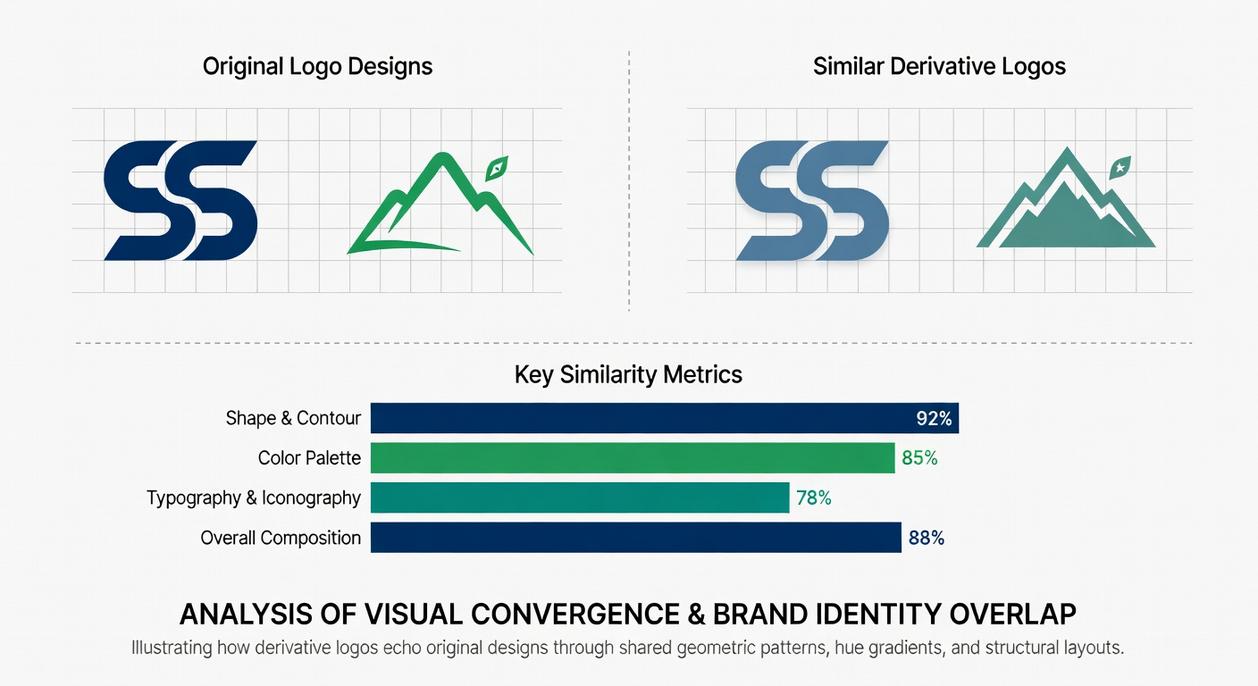
Industries develop what I call visual shorthand. A house silhouette for realtors. A globe for international shipping. A shield for security companies. These aren’t copyright violations. They’re conventions that help customers instantly understand what you do.
The line you can’t cross is execution.
Think about it this way. Using a tooth in your dental logo is fine. Copying the exact style, color palette, font treatment, and composition of another dentist’s tooth logo? That’s where you get into trouble.
I see this confusion all the time here in Springfield Township. A business owner shows me a logo concept and asks if it’s too close to a competitor’s design. What matters isn’t the concept itself but how you bring it to life.
Look at automotive brands. BMW, Porsche, and Alfa Romeo all use shield shapes. But you’d never confuse them. The artistic choices make each one distinct.
Same goes for tech companies and their swooshes. Nike owns theirs. But plenty of other brands use similar motion graphics without legal issues because the execution is different enough.
Now, some people will tell you parody gives you a free pass to copy anything. Not quite. Parody is a real legal defense, but it’s narrow and almost never applies to standard commercial branding. Unless you’re clearly making a joke that comments on the original, don’t count on it.
A Practical Due Diligence Checklist for Logo Design
Look, I’m going to be honest with you.
There’s no perfect system that guarantees your logo will never face a challenge. I wish I could tell you otherwise.
But what I can give you is a process that reduces your risk. A lot.
Most designers skip the boring stuff. They jump straight into creating something that looks good. Then six months later, you get a cease and desist letter from a company you’ve never heard of.
I’ve seen it happen more times than I want to count.
Step 1: Conduct a Thorough Trademark Search
Before you fall in love with a design, you need to search. The USPTO’s TESS database is free and it’s where you start.
Search for logos that look similar. Search for concepts that feel similar. Pay special attention to companies in your industry.
Here’s what nobody tells you though. The search results aren’t always clear. Sometimes you’ll find something that’s kind of close but not exactly the same. What do you do then?
Honestly? If you’re not sure, talk to a trademark attorney. I know that costs money. But it costs less than a lawsuit.
Step 2: Analyze the Competitive Landscape
This goes beyond legal searches.
Pull up your competitors’ websites. Look at companies adjacent to your space. What colors do they use? What shapes keep showing up?
The question people ask me is: can logos be similar flpstampive? And the answer is complicated. Legally, maybe. Strategically, probably not.
You want to stand out. If everyone in your industry uses blue circles, you need something different.
Step 3: Document Your Creative Process
Save everything. Your design brief. Your Pinterest boards. Your terrible first sketches (we all have them).
This documentation proves independent creation. If someone claims you copied them, you can show your work from day one.
I’ll admit I don’t know if this always holds up in court. But it’s better than having nothing.
Step 4: Prioritize Uniqueness in Your Design Brief
Tell your designer what you don’t want. Show them competitor logos and say “avoid this.”
Focus on your brand story. What makes you different? Your logo should reflect that.
Some designers push back on this. They say it limits creativity. Maybe it does a little. But you know what really limits creativity? Getting sued.
Check out logo directories flpstampive to see what’s already out there in your space.
The truth is, even following all these steps doesn’t guarantee you’re safe. The legal landscape around logo similarity is murky. Cases get decided on factors that aren’t always predictable.
But doing your homework? That’s the best shot you’ve got.
Building a Defensible and Distinct Brand Identity
You came here wondering if logos can be similar. Now you know the answer.
Some conceptual overlap happens. But direct resemblance creates real problems.
Following trends feels safe. It’s not. You end up with a logo that blends in and puts you at risk for infringement claims.
The solution is simpler than you think. Commit to originality. Do your due diligence. Understand the basics of trademark law before you design anything.
A unique logo isn’t just another business expense. It’s one of the most valuable assets you’ll ever own.
Here’s what to do: Before you finalize your logo, run a comprehensive trademark search. Hire a designer who understands brand differentiation. Make sure your mark can stand on its own in a crowded market.
can logos be similar flpstampive has the resources to help you think through these decisions. We’ve seen what works and what doesn’t.
Your brand deserves better than a copycat design. Build something memorable and legally sound from the start. Homepage.